Enough is enough!
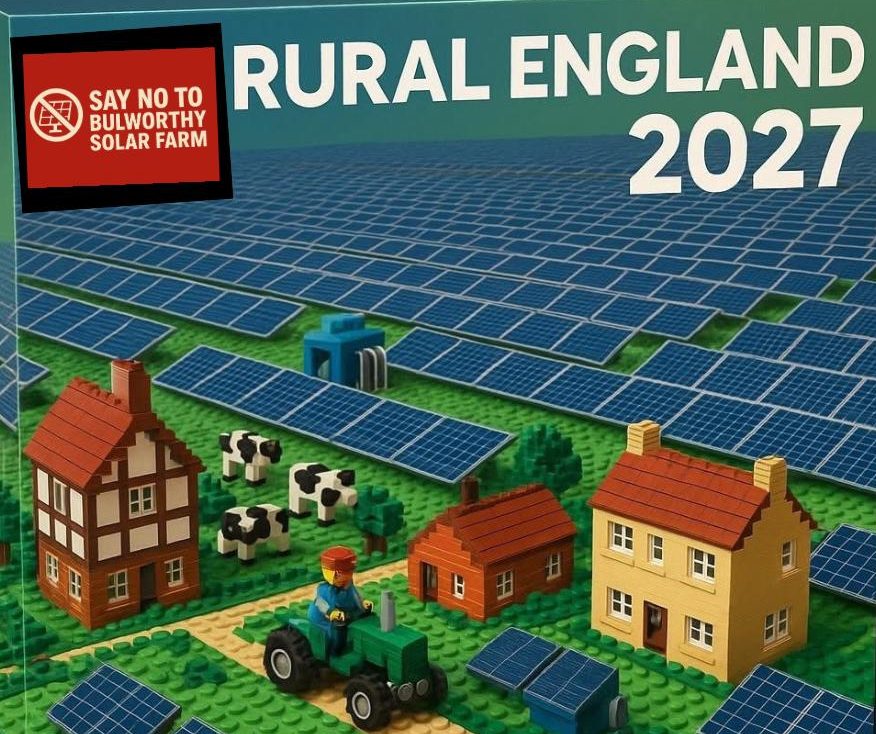
If the planning department don't stand up and do what they have been put in office to do, this is what we can look forward to. To be clear, this image is NOT 100% accurate but due to the developers reticence to provide clarity with regards to ALL current and planned Solar and BESS development to be (eventually) connected to Alverdiscott sub - station.
Solar and BESS to be connected to Alverdiscott.
Help to put Solar panels where they belong and protect our valued farmland.
A planning application to turn 275 acres (111.3 hectares = 156 football pitches) of quality farm land into a solar panel farm and BESS (Battery Energy Storage System) has been submitted to both North Devon District Council and Torridge District Council. Bulworthy is the most rural, scenic backwater imaginable and it is only its proximity to Alverdiscott National Grid sub - station that, along with existing local solar panel developments that make it so vulnerable to industrialisation. A further application is expected soon for a separate BESS development called Bideford BESS sited at Webbery Cross.
Solar energy plays a crucial role in reducing the global carbon footprint and should be a key part of the UK’s energy mix. However, its development must be responsible. Large-scale solar farms should not be built on Best and Most Versatile (BMV) land or productive farmland. Instead, they should be prioritized on industrial sheds, carparks, brownfield sites, and rooftops—locations that can provide renewable energy without compromising the environment, food security, or local communities.
The ‘Bulworthy Solar and BESS Action Group’ supports renewable energy but opposes utility-scale solar farms on greenfield sites and agricultural land. Such developments threaten rural communities by taking valuable arable land, disrupting landscapes, and causing significant environmental and ecological damage. Additionally, the associated traffic and construction work add to the burden on these areas.
This is not an issue of opposing renewable energy; it’s about protecting our land, environment, and future from corporate profit motives that put our rural areas at risk.
The merits of solar power is a matter of debate for States to determine.
The matter of where you put them however is a matter for local concern.
- The merits of solar power (and concern about global warming etc) is a debate for States to determine not local planning departments/councils.
- The matter of where you put them however is a matter for local concern and deliberation because they are best placed to understand where they cause the least damage/disruption.
- Farmland is chosen for solar simply for cost reasons and no other.
- The point of planning is that it weighs all elements of development (benefits and costs) so that hopefully a balanced decision can be made.
- Local authorities are refusing permission for these developments because the proposals fail this test (the benefit does not justify the damage).
- Solar can be located on industrial buildings, car parks, etc which have no other use (unlike land) but it is more expensive.
- Unfortunately, government policy and business (who are concerned about cost/profit only) are wholly aligned on this issue (by chance) and planning and local people by comparison are being ignored.
Stop Negative Change Through Action
Join a group of like-minded individuals committed to protecting valuable grade 3a and grade 3b farmland from industrial solar energy and battery storage development in the countryside.